


Free Introductory Lesson
Viola Lessons in Colorado Springs, Taught by a Philharmonic Musician
The viola is the warm, rich voice in the middle of the string section. It’s a little larger than the violin and a little lower, with a dark, mellow tone that many people find even more beautiful. Good violists are always in demand in school orchestras, youth symphonies, and string quartets. Learn from Angela Marvin, who plays with the Colorado Springs Philharmonic and the Chamber Orchestra of the Springs, at our studio on North Academy Blvd near Union. Your first lesson is free, so you can meet Angela and see how lessons work before you commit. Our violists come from school orchestras in Academy District 20, Fountain-Fort Carson D8, and Widefield D3.
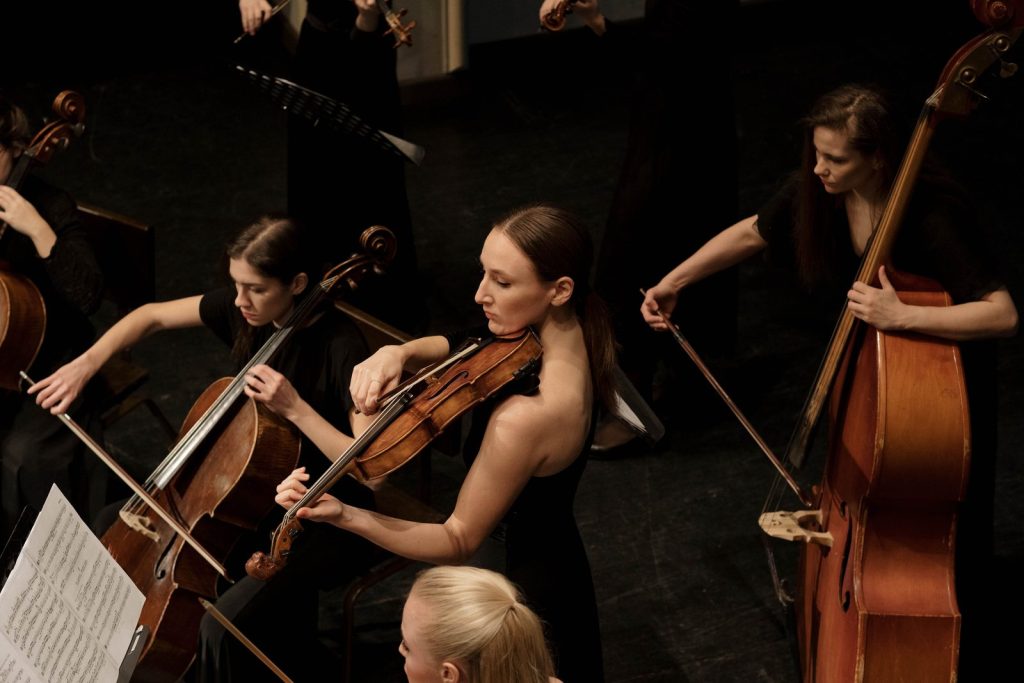
Who Viola Lessons Are For
- Young beginners. Violas come in smaller sizes, so kids can start on an instrument that fits them.
- Orchestra students working toward a stronger section sound, a better chair, or a spot in all-state or youth symphony
- Violinists switching or adding viola. It’s a common move, and orchestras and quartets are always looking for violists.
- College-bound violists preparing audition repertoire
- Adults who always wanted to play strings, or who played viola years ago

What You’ll Learn
Every lesson is shaped around your goals and the music in front of you. Along the way, most students cover:
- Posture and setup. The viola is bigger than the violin, so a comfortable, relaxed setup matters even more.
- Bowing. You’ll develop a controlled, relaxed bow arm that draws out the viola’s full, warm tone.
- Left-hand technique and intonation. Playing in tune is the biggest challenge for any string player, and steady feedback from a teacher makes all the difference.
- Reading alto clef. The viola reads mostly in alto clef, which is unique to the instrument. We teach it step by step.
- Shifting into higher positions, vibrato, and scales as you advance
- Music theory and musicality, including phrasing, dynamics, and how your part fits into the harmony
Every student moves at their own pace. Regular lessons matter on viola, because the bigger instrument and heavier strings call for a different bow arm than violin, and a teacher can set that up correctly from the start.
Meet Your Viola Teacher
Angela Marvin
Angela holds a Master of Music in Cello Performance from the Bob Cole Conservatory of Music. Her performance career has taken her from Hollywood studios and concert halls to tours across Europe and Asia.
A Working Orchestral Musician
Angela plays regularly with the Colorado Springs Philharmonic and the Chamber Orchestra of the Springs. As a teacher, she builds strong technical fundamentals while encouraging every musical curiosity. Read Angela’s bio
Book Your Free First Lesson
Tell us a little about the student, and we’ll email you within 24 hours to find a time. Prefer a call or text? Just let us know.
After your free lesson, private lessons start at $149 per month for a weekly 30-minute lesson, with no long-term contract. Rather talk? Call 719-722-0248
“My grandson is learning so much! Communication with the teacher has been great. The teaching is very tailored to the progress my grandson is making. We are very pleased.”
About the Viola
The viola is the alto voice of the violin family. Its four strings are tuned C, G, D, and A, a fifth below the violin and an octave above the cello. In the orchestra and the string quartet, it often fills in the inner harmonies that make the music sound full, but it gets plenty of melodies too.
Some of history’s greatest composers loved the viola. Mozart and Beethoven both played it, and Mozart wrote his beloved Sinfonia Concertante for violin and viola. Berlioz’s Harold in Italy and Richard Strauss’s Don Quixote feature it as a solo voice, and Bartók and Walton wrote major viola concertos in the 20th century. Today you’ll also hear the viola in film scores, folk music, and indie rock.
More Ways to Grow
When you’re ready, play with other students in our ensembles and perform in student recitals. We also teach violin and cello, so siblings can study strings at the same studio, and many of our string players add piano lessons for theory and ear training.
Frequently Asked Questions
I play violin. Is it hard to switch to viola?
Most violinists adjust quickly. The biggest changes are getting used to the larger size, the heavier bow, and reading alto clef. A few lessons focused on the switch can save months of figuring it out on your own.
What’s the difference between a viola and a violin?
The viola is slightly larger, is tuned a fifth lower, and reads mostly in alto clef instead of treble clef. It has a deeper, warmer sound. The playing technique is very similar, so many students play both.
What age can my child start viola lessons?
Many children start between ages 6 and 9 on a smaller viola sized for them. Others begin around fourth or fifth grade when they join school orchestra, or switch from violin when their orchestra needs violists. Adults are welcome at any age.
Do I need my own viola?
Yes, you’ll need one for lessons and practice at home. Most families rent at first, since young players move through several sizes as they grow. Violas are sized in inches rather than fractions, and we’re happy to help with sizing and choosing an instrument.
How long are lessons, and what do they cost?
Choose 30, 45, or 60-minute private lessons. Your first lesson is free, and lessons start at $149 per month for a weekly 30-minute lesson after that, with no long-term contract.
Schedule Your Free Viola Lesson
Meet Angela, talk about your goals, and see if lessons are a good fit. Call us at 719-722-0248 or send us a message to book your free introductory viola lesson.
Rocky Mountain Academy of Music · 5426 North Academy Blvd, Ste 101 · Colorado Springs, CO 80918